What is agentic coding?
You've barely digested vibe coding and LinkedIn is already talking about agentic coding. Another buzzword? Not this time. Behind the word, there's a real shift in how software gets built with AI.
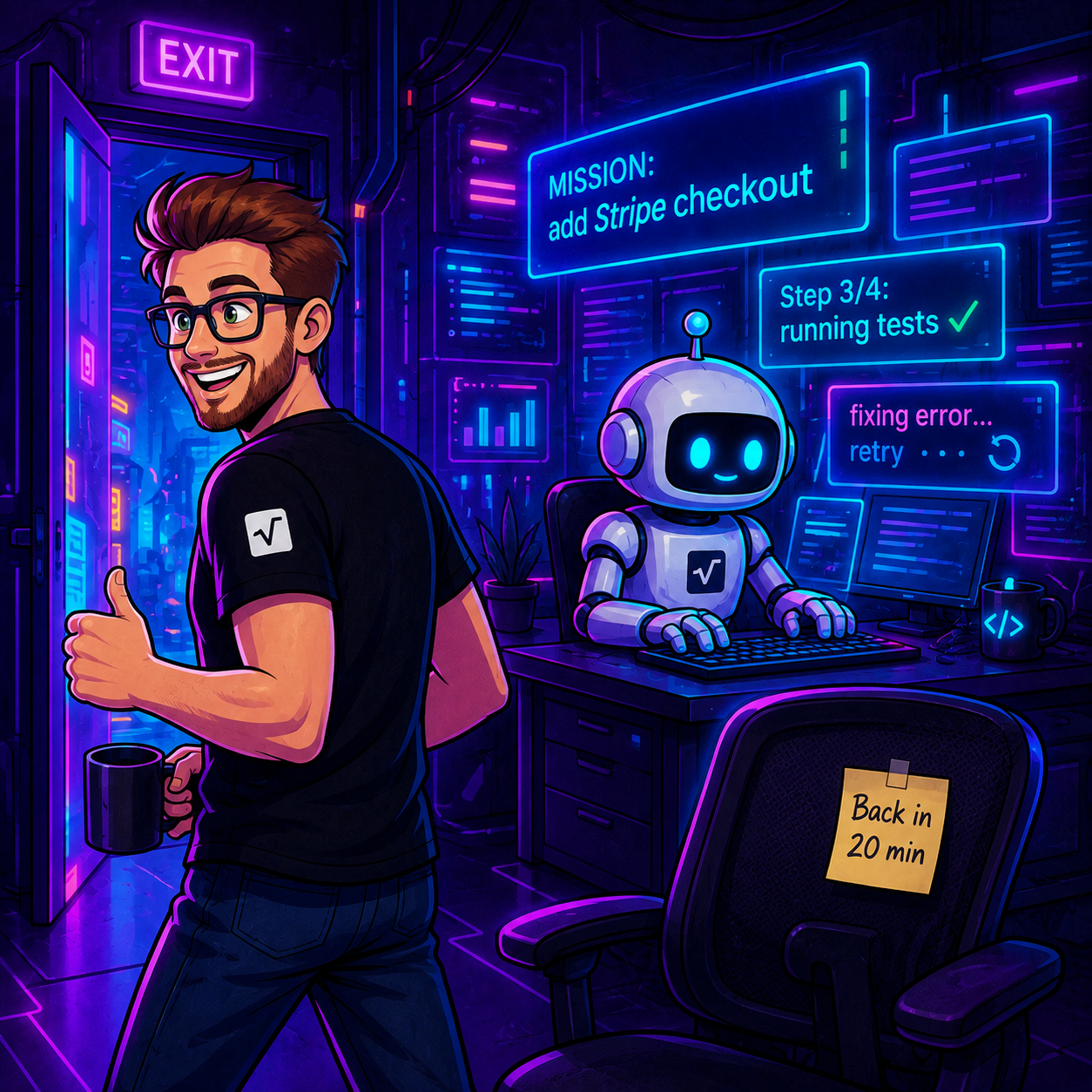
Agentic coding means handing a complete mission to an AI that works alone inside your project: it reads your code, writes, runs commands, tests, fixes, and comes back to you when it's done.
The difference with vibe coding isn't the tool. It's the level of delegation.
Vibe coding is dictating to someone who types in front of you. You describe a screen, you see the result, you adjust. You validate every step.
Agentic coding is handing a mission to someone who goes off to work and comes back with the result. "Add Stripe payments to my site, with the invoice sent by email." You come back twenty minutes later, it's done. Or not. More on that below.
If vibe coding is still fuzzy for you, start with the complete guide. This article is the logical next chapter.
Where does it come from?
The word "agent" simply means: something that acts. An "agentic" AI doesn't just answer you, it's allowed to do things. Open files, run commands, modify your project.
The evolution happened in three steps.
First, AI that completes. The early coding assistants suggested the end of your line, like your phone's keyboard suggests the next word.
Then, AI that answers. You describe what you want in a conversation, it generates the code, you copy-paste or approve. That's the vibe coding era, the one that made Cursor, Bolt and Lovable explode.
Finally, AI that acts. Models became capable of working for a long time without going off the rails. Tools like Claude Code and Codex gave them hands: access to files, to the terminal, to tests. The "try, read the error, fix, retry" loop you used to do by hand, the agent now runs on its own.
That last jump is what we call agentic coding.
How it works in practice
The workflow looks like this:
- You describe a mission, not a screen. "Customers should be able to cancel their subscription from their account, with a confirmation email."
- The agent explores your project. It reads your existing code to understand how things are built, then proposes a plan.
- It executes. It writes the code, runs the app, executes the tests (automated checks that verify nothing is broken). When something fails, it reads the error and fixes it. Without you.
- It presents the result. A summary of what it did, what it changed, what it verified.
During step 3, you can go do something else. That's the real change: your time is no longer blocked by the building. It moves to two moments, before (framing the mission well) and after (checking the work).
Vibe coding vs agentic coding
| Vibe coding | Agentic coding | |
|---|---|---|
| What you ask for | A screen, a change | A complete mission |
| What you validate | Every step, live | The final result |
| Your role | Pilot | Client giving orders |
| The risk | Moving forward without understanding | Delegating without checking |
The two approaches coexist. To tweak a color or a label, the conversation mode stays simpler. For a whole feature, the agent goes faster and further.
The tools right now
Three names come up everywhere in 2026:
- Claude Code (Anthropic): the agent that made the category popular. It works in the terminal, directly inside your project, and it's the current reference for autonomous work. I wrote a complete guide for non-developers about it.
- Codex (OpenAI): OpenAI's answer. You can hand it missions that run remotely while you do something else.
- Cursor: the star editor of vibe coding added an agent mode, halfway between the two worlds.
All-in-one platforms like Lovable and Bolt are adding agent capabilities too, each at their own pace. The market moves every month: to choose based on your stage, I wrote a comparison of the tools.
What it changes if you vibe coded your app
This is the most important point in this article.
An agent amplifies whatever already exists in your project.
It reads your code before writing its own, and it imitates what it finds. If your foundation is clean, it builds fast and right. If your foundation is shaky, it stacks floors faster than you ever did, reproducing the same flaws.
Imagine bringing a crew of ten very fast workers onto a construction site where the foundations are crooked. The house goes up impressively fast. Crooked.
Concretely, on a vibe coded app with no supervision, an agent will:
- Reproduce the existing shortcuts. A missing validation, a badly handled password: it sees "that's how it's done here" and keeps going the same way.
- Multiply the duplication. Logic copied three times becomes logic copied ten times, faster.
- Make the cleanup more expensive. The more the agent builds on a fragile base, the more the rebuild will cost, the day it becomes unavoidable.
So agentic coding doesn't make the quality of your foundation less important. It makes it more important than ever.
The honest limits
This is the part the demos don't show you.
The agent is confident, even when it's wrong
It announces "done, everything works" with the same aplomb whether it's true or not. The demo works, and the edge case breaks silently. I've already written about why an AI-coded app nails the hard part and fails the dumb part: with an agent, that phenomenon is multiplied, because it produces more code in less time.
Nobody reviews
In vibe coding, you validate every screen, you see what's happening. In agentic coding, the agent delivers a batch of changes all at once. If nobody on the team can read code, nobody reviews. And mistakes pile up quietly, until the day they get loud.
It has the keys to the house
An agent has access to your files, your terminal, sometimes your database. A badly framed mission can touch things it shouldn't have. Professionals work with guardrails: separate environments, backups, systematic review before going live. If those words mean nothing to you, the security risks of vibe coding apply to agentic coding too, at a bigger scale.
It costs money
Agents consume far more than a conversation. A simple mission costs a few dollars, a mission that loops on a problem can cost much more. Still cheaper than a developer, but no longer "included in the $20 subscription".
So, is it for you?
It depends where you are.
Validating an idea? Stay on an all-in-one platform. Prototype speed matters more than anything else, and you don't need an agent for that.
Your product has real users and it's growing? Agentic coding is the next step. But remember the paradox: the more you delegate, the more the framing matters. Delegating to an agent looks more and more like delegating to a developer. You need to frame the mission, review the work, test before going live. It's not less rigor than vibe coding. It's more.
And that's exactly the job that's emerging: experienced developers who drive agents, with the guardrails that go with them. A senior equipped with agents now delivers what a small team used to, for a fraction of the budget.
There's one question the agent will never settle for you: what to ask it for. When building costs almost nothing, picking the right feature becomes the real work.
And there's one decision it will make for you if you don't make it yourself: your stack. Every new project started without instructions lands on different choices. Write it down before you launch the first mission.
Want the speed of agents, without the blind spots?
That's exactly how I work: agentic coding for speed, a senior's experience for the framing, the review and the production launch. If you're looking for someone to build or take over your product, check out my custom development offer.
Already have an app and want to know if its foundation is healthy enough to handle this pace? Book an audit: in 3 days, you know what's solid, what's risky, and what to fix first.
And to keep up with how fast building with AI is changing, sign up for the newsletter. No spam, just what you need to know.